MHR / UX leadership · Design operations
Aligning UX around product priorities.
I led the transition from embedded designers to a centralised UX team, bringing shared priorities, clearer ownership and more consistent engagement with Product and Engineering. Feedback showed stronger collaboration, alongside practical issues that needed further attention.
- My role
- Senior UX Designer, acting Head of UX
- Context
- MHR
- Timeframe
- 2025
- Collaboration
- Five Senior UX Designers and four UX Designers
The outcome in brief
A clearer operating model, informed by ongoing feedback.
The challenge.
The change covered People First and iTrent, two enterprise products spanning HR, workforce management, payroll and finance. Designers were embedded in separate product teams, so the same patterns could be solved more than once. Approval journeys for expenses, holidays and transfers were a useful example: related problems were being approached independently, without enough shared learning.
The challenge also affected how I led the team. Workloads were difficult to coordinate, standards varied, and designers had limited visibility beyond their own area. I needed to connect product priorities with capacity and clearer ownership of quality, accessibility and development. Our success criteria included earlier UX involvement in discovery, stronger stakeholder confidence, reduced duplication and better alignment to quarterly product plans and OKRs. These were aims for the model, while delivery continued through the transition.
Scope: Centralised UX operating model for People First and iTrent, across HR, workforce management, payroll and finance software.
My contribution.
- Diagnosed the existing structure, delivery practices, duplicated work and concerns across UX and product teams.
- Defined the proposed operating model with the Head of Product, Product Managers and Principal Designers.
- Established ownership and engagement expectations across discovery, delivery, accessibility and quality assurance.
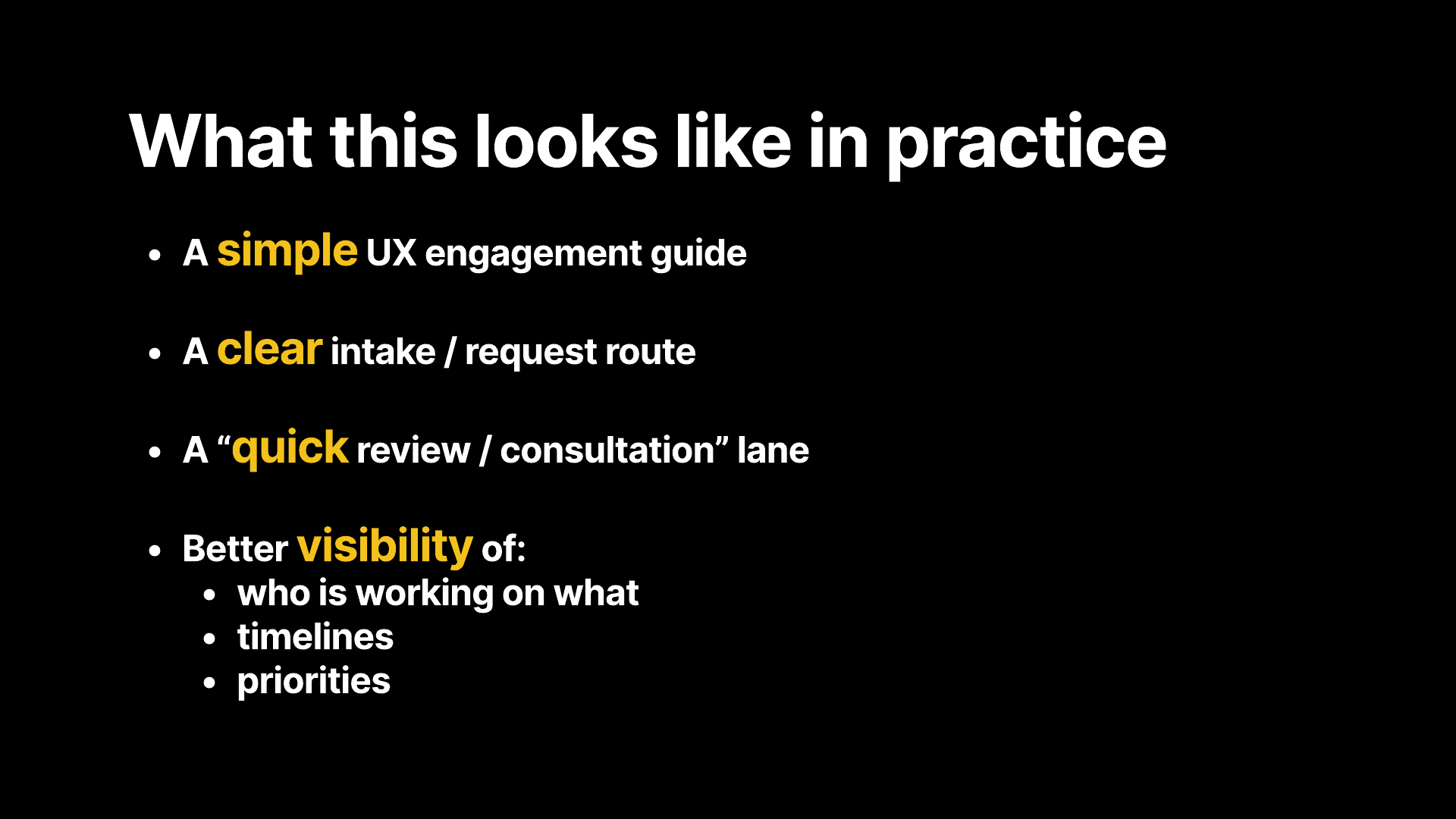
- Led communication, workshops and feedback review, then used the findings to improve intake and visibility.
From separate teams to a shared UX function.
01 / Diagnose
Understand the work and the concerns
I reviewed how the team was organised and how design moved through delivery, looking for overlaps, inconsistent practices and unclear responsibilities. Feedback from Product Managers, Engineering, QA and Delivery helped me see the engagement problems from outside UX. Conversations with designers brought out isolation, reactive work and uncertainty about how a different structure would affect them.
02 / Define
Give shared responsibilities an owner
With the Head of Product and Product Managers, I shaped a central team aligned to strategic priorities. Planned allocations would replace permanent embedding while keeping designers involved with product teams. We defined responsibilities for design systems, accessibility, research and insight, quality assurance and sign-off, giving work that crossed product boundaries a place in the operating model.
03 / Connect
Make engagement part of delivery
We introduced shared intake and prioritisation with Product leadership, then defined engagement points through discovery, delivery and release. Refinement, accessibility checks and smoke testing became explicit expectations. Making UX tasks accountable within delivery workflows helped explain when design support was needed and what teams could expect from it.
04 / Improve
Use feedback to adjust the model
I co-created and presented the model with Principal Designers, explained the reasons for the change and used follow-up workshops to hear concerns about access, ownership and speed. I presented the approach to Product and Engineering leadership to gain alignment. Once it was in use, structured feedback loops with Product Managers and designers showed what was working and where everyday coordination still needed attention.
What team feedback told me.
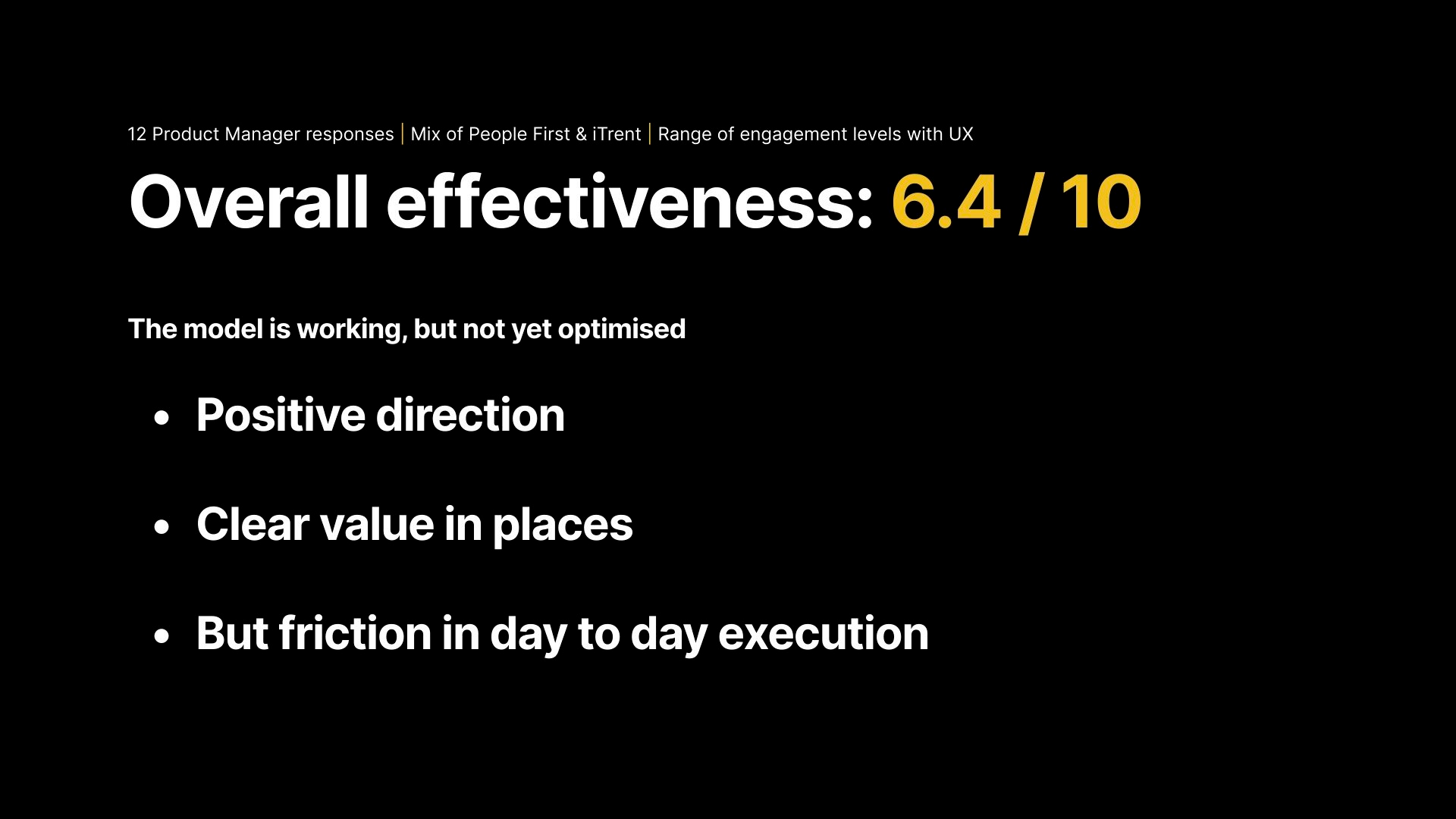
- FindingProduct Managers were positive about communication, design rationale and handover. Friction remained around when to engage UX and which types of support were available.
- ResponseI used the feedback to refine intake and engagement. The model was working, but not yet fully optimised.
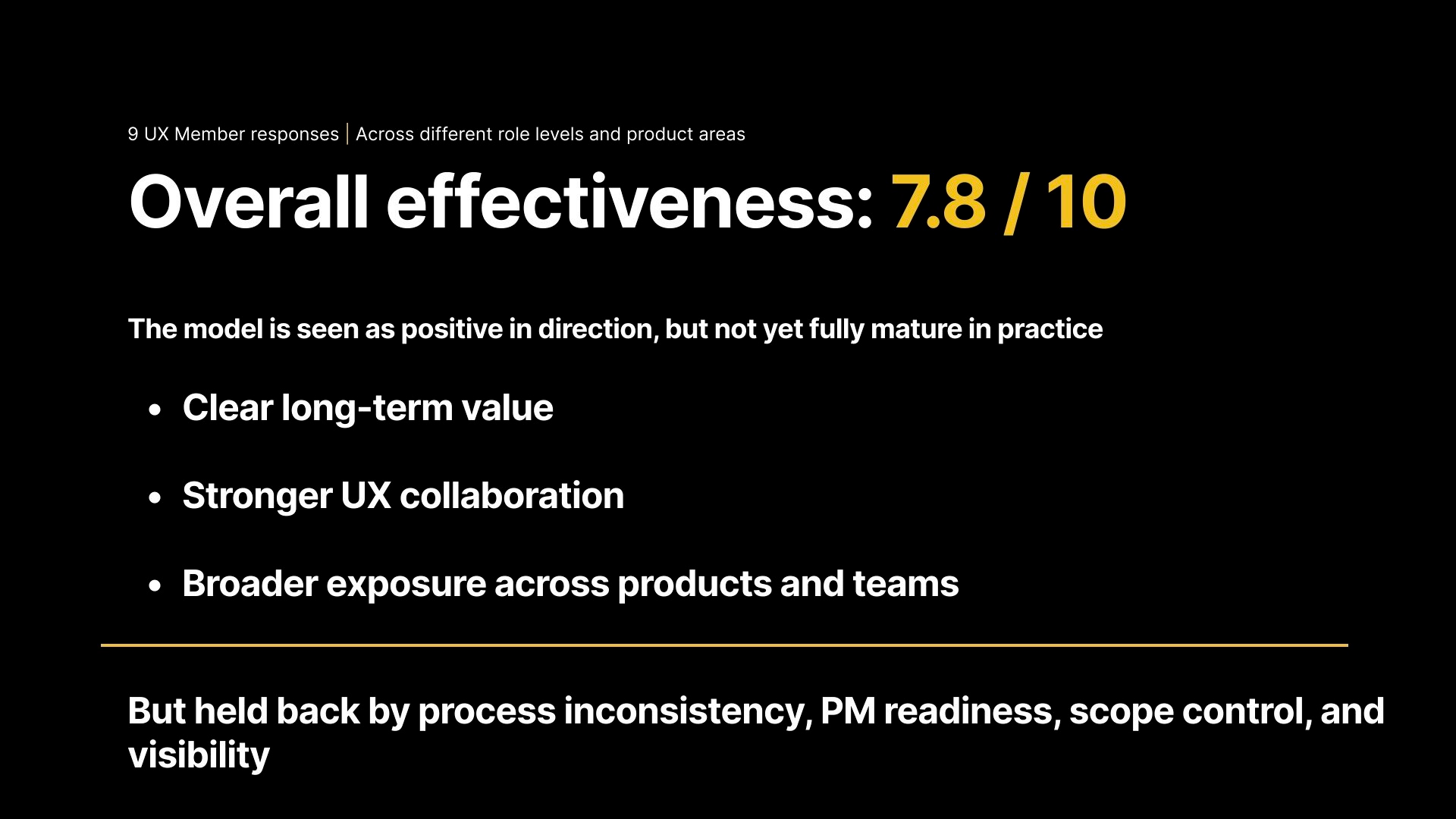
- FindingDesigners felt more connected and supported, with stronger collaboration and exposure to other products. Briefing quality and scope still varied.
- ResponseI began shaping structured briefing and CURB-based intake to improve the quality, readiness and triage of work entering the team.
- FindingBoth perspectives exposed gaps in visibility: active work, ownership, priorities and workload were not clear enough.
- ResponseWe introduced a shared Teams Planner Kanban board to make assignments, timelines and priorities visible.
- FindingProduct teams worried about losing dedicated access, while designers were uncertain about allocation and their connection to feature teams.
- ResponseI addressed concerns through transparent communication, workshops and documentation. Maintaining a useful connection with feature teams remained part of improving the model.
The decisions that mattered.
Plan capacity without losing product context
A central team needed to support product delivery as well as shared priorities. Planned allocations gave us a way to coordinate capacity while keeping designers involved with the teams and problems they supported.
Treat quality as part of the workflow
Accessibility and design quality could be seen as delays. I made the expected checks and responsibilities explicit within delivery, so teams could plan for them and understand the contribution UX made through release.
Keep the operating model open to change
The first structure was not the end of the work. I used the different experiences of Product Managers and designers to identify practical adjustments, rather than treating a positive overall response as proof that the model was fully optimised.
What changed.
Designers reported feeling more connected, with stronger collaboration, support and exposure to other products. Product Managers responded positively to communication, design rationale and handovers. The model was working, but briefing quality, workload visibility and connections with feature teams still needed improvement.
The change created a shared UX function with clearer responsibilities and a common approach to engaging with Product and Engineering. Feedback also gave us a concrete improvement agenda: better briefs, clearer work visibility and stronger connections with feature teams. Planner and the developing intake approach were responses to those issues, rather than evidence that every issue had been resolved.
The 2026 follow-up added two perspectives: 12 Product Managers rated overall effectiveness 6.4/10 in April, and nine UX team members rated it 7.8/10 in May. These snapshots describe how the groups experienced the model; they are not a before-and-after measure of delivery performance.
What the evidence can tell us
The published follow-up combines qualitative comments with team and stakeholder perception ratings. It does not quantify before-and-after changes in delivery speed, product quality or accessibility.
What I learned.
Centralisation needs a clear way for product teams to access UX support. Shared standards and priorities matter; timely engagement, useful briefs and visible workloads make the operating model effective day to day.
I learned to look at the model from both sides: designers need collaboration and support, while product teams need reliable access and clarity. The usefulness of centralisation depends on how those needs are handled in daily work.